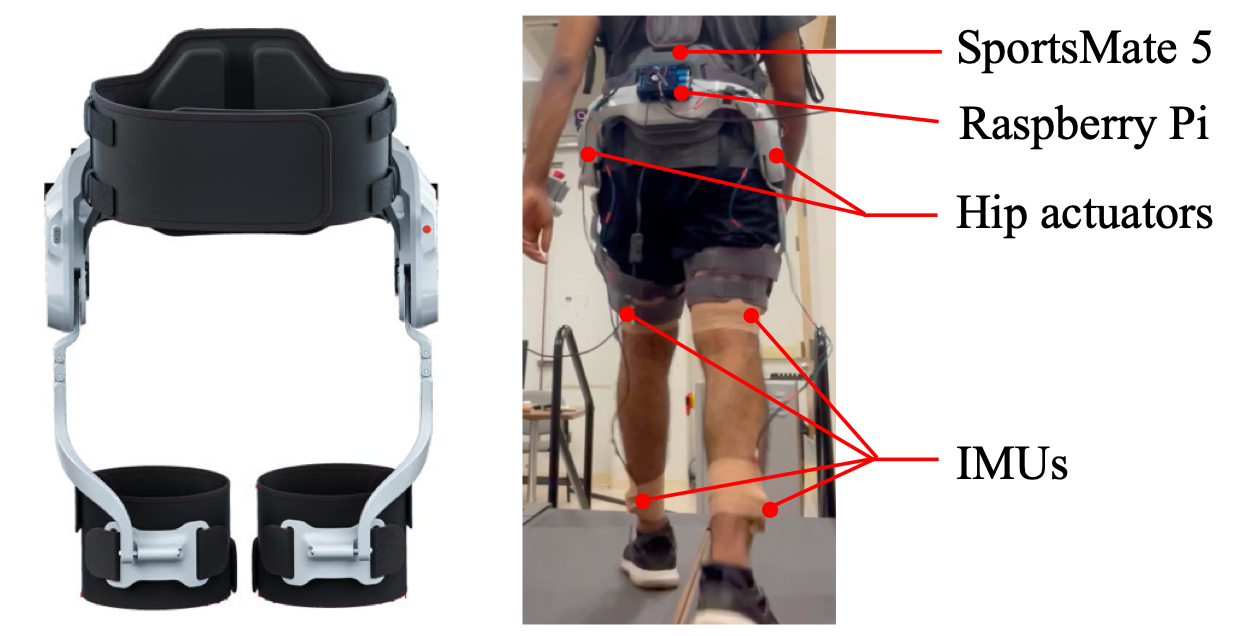
The relationship between control parameters and human effort varies across individuals and locomotor activities. We combine task-agnostic assistive strategies with sample-efficient optimization to customize lower-limb exoskeleton assistance.
Customization objective
Although energy-shaping strategies can provide task-agnostic assistance, their parameters influence the resulting human joint torques and energetic demands. A systematic customization framework is needed to identify appropriate parameters across users and tasks.
Optimization framework
We investigate derivative-free, sample-efficient optimization in conjunction with energy-shaping control. The framework searches for assistive parameters using human performance-based objectives while retaining a task-agnostic controller structure.
The customization loop
- Set the assistance. Choose parameters within an energy-shaping strategy.
- Evaluate the response. Assess the resulting movement and effort objective.
- Update the parameters. Use optimization to search for improved assistance.
Simulation and computational studies
Simulation studies of the learning framework demonstrate reductions in modeled human joint torque and metabolic cost. Related work investigates a two-layer human-in-the-loop optimization structure and physics-informed neural networks for solving the energy-shaping matching condition. Simulation findings are distinguished from experimental validation.